impact PARTNERS

Partnerships with purpose.

1% for the Planet Impact Partners are vetted organizations working toward a wide array of solutions, from climate justice and urban infrastructure to gender equality; indigenous land rights to supply chain sustainability; conservation policy to environmental education, and beyond.
Today, we have more than
12803
30
56
64
110
8562
4241
939
partners in
12803
30
56
64
110
8562
4241
939
different countries.
Get to know our partnerschevron shape
skip logo marquee

Our impact areas

Our vetted impact partners are categorized into four areas.
01
IMPACT Area

Rights & access

The rights and access impact area focuses on four impact targets: environmental democracy, land and water rights, community conservation, and nature access.
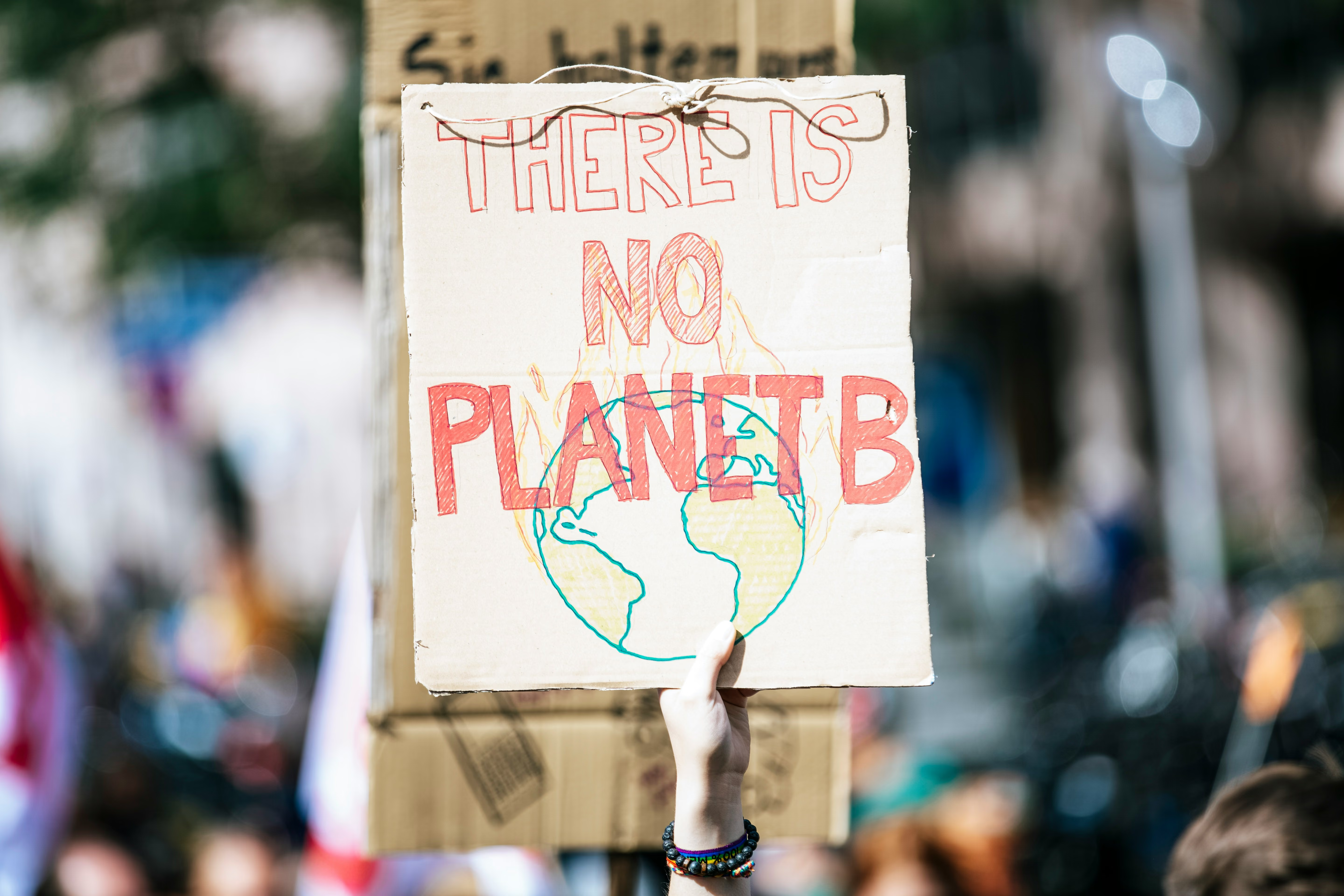
a protest sign saying there is no Planet B

Environmental Democracy

Securing the legal, political, and civic rights of populations to influence environmental laws, hold systems accountable, and drive systemic action.
people around a fire at a land connection ceremony

Land & Water Rights

Ensure the legal rights of Nature and of Indigenous Peoples and other stewards who use, enjoy, and care for Nature and its resources.
a group of people thrashing quinoa

Community Conservation

Engage local communities and local knowledge in decision-making on land, water, biodiversity, and natural heritage site conservation and use.
person hiking along a body of water near mountains

Nature Access

Improve access and belonging to natural spaces and other nature-based activities for all people, particularly vulnerable, marginalized, or excluded communities.
a bison standing in a plain

Biodiversity & Wildlife

Support biodiversity and prevent the extinction of threatened species.
Angelfish on a coral reef

Marine Ecosystems

Protect, conserve, and ensure sustainable use of marine and coastal ecosystems.
riverbed in a rocky cavern

Freshwater Ecosystems

Protect, conserve, and promote sustainable use of freshwater resources.
a photo of the dolomite mountains with a meadow of wildflowers

Terrestrial Ecosystems

Protect, conserve, and ensure sustainable use of forests, grasslands, deserts, tundras, mountains, and soils.
02
IMPACT Area

Conservation & restoration

The conservation and restoration impact area focuses on four impact targets: biodiversity and wildlife, marine ecosystems, freshwater ecosystems, and terrestrial ecosystems.
03
IMPACT area

Resilient communities

The resilient communities impact area focuses on four impact targets: climate adaptation, sustainable cities, toxics and pollution, and environmental education.
solar sister employees holding up  solar lights

Climate Adaptation

Mitigate natural disasters and other climate risks through emergency responses and resilience planning, including family planning services and gender equality in education.
a bike lane in a city

Sustainable Cities

Improve the livability and impacts of populated places through green and built infrastructure, safe housing, waste management, and alternative transportation.
a barge removing waste from a river

Toxics & Pollution

Reduce human and ecosystem exposure to hazardous chemicals, pollution, and other contaminants.
young children planting in a garden

Environmental Education

Support education on environmental issues, skills, traditional knowledge, and science that lead to environmental appreciation and sustainable lifestyles.
volunteer fixing a road bike

Market Transformation

Decoupling economic activity from environmental degradation by redesigning the operational and financial structure of the economy.
a farmer leaning over a saddled animal, like a horse

Sustainable Livelihoods

Replacing hazardous, extractive, illegal or destructive economic activities and lifestyles with those that restore environmental quality.
solar farm next to a highway

Energy Transition

Shifting the global economy from fossil fuels to low-emission systems, and reducing greenhouse gases across all sectors.
young kids holding kale in a greenhouse

Food Systems

Improve food security, food sovereignty, and food production through sustainable agriculture practices, waste diversion, food banks, equitable distribution, and food system localization.
04
IMPACT Area

Just economies

The just economies impact area focuses on four impact targets: market transformation, sustainable livelihoods, energy transition, and food systems.

Our vetting standard:

The 1% for the Planet partnership assessment is our way of ensuring a high-quality impact partner network.

To determine eligibility for the 1% for the Planet Impact Partners network, organizations must satisfy the following:

1

Member recommendation

Current 1% for the Planet Business Members nominate environmental organizations they wish to support. Members log in here.

2

Vetting assessment

Our internal vetting team evaluates the organization’s governing documents, legal structure, financial transparency, and audit scopes.

Learn about our Certification and Vetting Standard (PDF)

3

Approval & network integration

Approved partners receive an official profile in our Partner Directory, enabling them to receive certified 1% member contributions.

Our vetting pillars

Pillar 1

Legal accountability

Does the organization have a durable commitment to an
environmental mission?
We verify binding legal commitments ensuring funds serve the public good. Nonprofits must hold an Asset Lock prohibiting private profit distribution. Enterprises must demonstrate a legally binding Mission Lock (e.g., Benefit Corporation status, Steward Ownership, or Nonprofit ownership).

Pillar 2

Organizational credibility

Is the work of the organization transparent, ethical, and externally validated?
Partners must publish public impact reports, pass a 3-year adverse media and risk screening (evaluating governance, financial integrity, and greenwashing risks), and prove operational capability through accredited audits, expert boards, or institutional backing.

Pillar 3

Solutions alignment

Does the organization offer programs or services that drive positive environmental results?
Solutions offered by partners must map directly to valid environmental outputs, and some solutions require third-party audits.

Our impact partner network

Nonprofit Impact Partner

Partnered nonprofits with a majority of their total programming budget mapped to aligned environmental indicators. As their primary purpose is environmental, all forms of support qualify as certifiable 1% contributions.

Program Impact Partner

Partnered nonprofits with a minority of their total programming budget mapped to aligned environmental indicators. Certifiable contributions are restricted to approved programs.

Enterprise Impact Partner

Partnered mission-locked social enterprises providing approved environmental solutions for public benefit. Certifiable contributions are restricted to approved solutions.

Eligible Organization

Nonprofits not formally affiliated with 1% for the Planet but that have passed the vetting standard. Certifiable contributions can be either unrestricted or restricted to approved programs.

Want to learn more? 

Whether you are a business looking for high-impact partners or an environmental organization seeking to understand our governance standards, we provide complete transparency into our network.

Partner directory

Emergency response

Mobilizing our network for urgent environmental action

When emergencies happen, 1% for the Planet compiles lists of vetted, reliable impact partners providing urgent aid and recovery efforts.

Explore how you can support critical emergency response efforts through trusted partnerships.

Emergency response archive
people making and delivering food in a world central kitchen location
Female leadership ignites tropical rainforest recovery in the Amazon
Through women-led bio-enterprises, Chiki Chiki Boom Boom and Rainforest Partnership are protecting rainforests and indigenous communities.
Read this story
Mad Agriculture and the grain revival movement
Mad Agriculture works to preserve local biodiversity and improve the nutritional value of crops through traditional seed-saving methods.
Read this story
a person in a greenhouse of vegetables looking at the camera
Four environmental partners using education to uplift women
Access to education is key when it comes to uplifting women's voices–especially in the environmental space.
Read this story