Tru Earth CEO Brad Liski on the ROI of 1% for the Planet membership, justifying ESG to boards and why 1% is a small price for the future.
Brad Liski is the CEO of Tru Earth, a company driven by a critical cause to make true lasting change that cares for your future. Tru Earth is on a mission to eliminate plastic waste and reimagine the way we care for our homes, starting with their innovative eco laundry sheets. Since becoming a 1% for the Planet member in January 2025, Tru Earth has contributed more than $1 million in certified giving, supporting impact partners in the fight against hygiene poverty and marine plastic pollution.
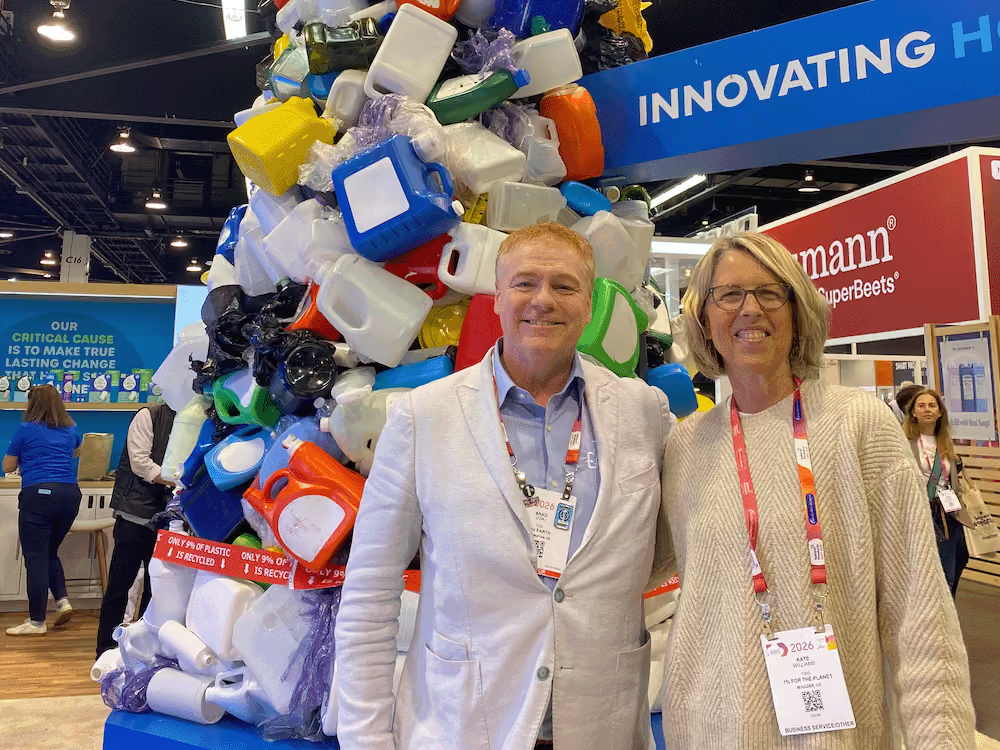
Our CEO Kate Williams recently joined Brad for a dynamic Earth Month conversation as part of the Our Planet Talks virtual series. Watch the full recording, or dive into the transcript below.
Kate Williams: You've only been a member since last year, but boy, you are the embodiment of a courageous leader, as is your company.
My first question gets to the heart of Earth Month. Our Earth Month campaign this year is about turning care into commitment. So we'd love to hear how Tru Earth has baked environmental commitment into your business model from the beginning, and what led to your decision to back it up with 1% for the Planet certification.
Brad Liski: Every year, we dedicate well over 1% of our sales to trusted environmental and social partners, and always have. In fact, we've given way more than we made in profit. Because stewardship isn't simply something that we talk about. It's something we actually live. It's in our DNA. It's not enough for our values to be painted on a wall. They have to be part of the daily decisions, holding ourselves accountable, ensuring our actions back up our words.
As part of your global network at 1% for the Planet with companies striving for real, impactful, measurable impact, we know we're not alone. Being part of this group together, we can drive meaningful change. As we've said many times, it takes many small hinges to swing this massive door of change, and even more so today. So we believe in supporting credible nonprofits that are tackling these big, urgent, wicked problems; these environmental, social challenges.
You guys help us validate our purpose, certify the good we do, because purpose is at the core of our growth.
Kate Williams: You said that you've already given more than you've made in profit, and you don't hear that from many CEOs of large, growing companies. How have you sold that to your board? How do you make the case for that? As a business leader, how have you ensured that it’s not something that could be cut when the going gets tough?
Brad Liski: There's a combination of why you do a triple bottom line, and it's not just a number for us; it's real. So we put actual economics behind our social impact, our environmental impact and our financial impact. And you do have to have all three. You do need to make a profit. But when it comes to doing social and environmental good, it's a combination of the fact that it's the right thing to do and it’s an investment in our future.
Tru Earth is designed to be a multi-generational brand; it is meant to disrupt. To do that, we need to make sure we invest in that future. So when talking with the Board of Directors and shareholders, we had to do some pretty tough governance stuff. First, putting together the right board was critical, and the right investor stack that understood why we were who we were.
Then we went the extra distance and registered as a public benefit corporation, so not just a B Corp—we are a certified B Corp, but we’re also a registered public benefit corporation. At the beginning of every board meeting, we are reminded that we have a fiduciary responsibility to social-environmental impact; that every decision we make during that board meeting must be a factor for our critical cause and the public benefit statement. Now we're surfacing that into the staff and into the crew.
Sometimes people forget that we're a social venture, right? We're in the CPG world. We're supposed to be drive profits, right? Capitalism first. I've been a capitalist through my entire career, but, at the same time, the social venture is real, and we need to make sure that we give back in order to survive.
Kate Williams: That's great. I really appreciate that you use the word governance and describe some of the really nitty-gritty details of how it works. I think it's important for the audience, whether you're a member or you're considering membership, to know that the passion of doing this work almost always needs to be backed up with some pretty detailed work. And the beauty of this community is that it creates partners and colleagues like Brad and others who have rolled up their sleeves and done some of the work to figure out what the kind of daily-grind types of things are that need to be done to ensure that this happens.
I'd love to talk about the role that 1% for the Planet has played as a partner in this, in really locking it down, putting the stakes down, for what you're building.
Businesses navigate a lot of uncertainty. Since joining, how you have navigated that uncertainty, and how has 1% for the Planet surprised you as a partner in how to make your way forward?
Brad Liski: I have to say, what's really surprised me since joining 1% for the Planet is just how quickly meaningful partnership opportunities have come up.
Truly, the number of doors that have opened has far exceeded what I expected.
Too often, a company gets certified, and then the only time there's a connection is when the bill is due for renewal.
So what's made the biggest impression on me is how genuinely collaborative the community is, not just about making the connections, but about building real, values-driven partnerships. We've always found ourselves working on new creative projects, which is something we hadn't anticipated.
Being part of this network isn't just about giving back; it's about amplifying our impact together—shared stories, platforms, collective actions, all of those things I did not expect.. I thought, “We're just going to certify all the good we were already doing anyway. Give me the logo. I'm ready to go.” But in reality, we really unpacked this entire network of value.
Kate Williams: Let's drill into the ways that you've delivered that value, because you have taken a really holistic, creative approach in giving, through cash, through products, through employee volunteering. How has that been a part of this wonderful partnership landscape that you've built?
Brad Liski: Well, frankly, it comes down to basic human interaction.
So just listening, trying to understand what the nonprofit partners—the experts in their communities—need. So, knowing that our customers come from many parts of the world, we need to have partners that have the same kind of values alignment. So it's never about just a one-off donation: you buy, I give. It's about building some long-term, reliable relationships that our partners can count on year after year.
Take, for example, the Daily Bread Food Bank. They are one of our 1% for the Planet environmental partners, and together, we've delivered five million loads of laundry detergent over the last five years—so helping nearly one million people have clean clothes for at least a month.
Hygiene poverty must end, and we feel like clean clothes are a human right.
That same approach applies to a five-year partnership with Ocean Wise. We have not only grown together, but have become a founding partner of the U.S. shoreline cleanup program.
Kick things off with small pilots and test projects. Just be open-minded to what [our partners] know that we don't.
This is one of the things we talk about as to how to get the board on our side. Every value partnership we have has a value exchange documented. What are we giving? What are we getting? Not from a selfish perspective, but so that I can justify it. Because when the budget cuts come, and they always come, you better be able to justify every relationship you have and why, especially the longer-term ones, because sometimes they get a little bit questionable, or new leadership wants to make a change. For us, the key to surviving these budget cuts and restructures is making sure we have this documentation as to why we're doing what we're doing with who.
Kate Williams: You've done such a great job of connecting the heart of these amazing partnerships that are driving real impact on the ground with the head of needing to document and lock it in so that it has a better chance of moving forward.
I know from the wonderful interactions I have had with some of your team members—shout-out to Anita Spiller and Kate Huibers, and others I haven’t met yet—that they're behind a lot of bringing this to life on a day-to-day basis. I'd love to have you talk about how your team has played a role in bringing 1% for the Planet to life internally, and how it's impacted your culture and employee engagement.
Brad Liski: Our commitment wouldn't have the power it does without the people who live it every day. And yes, I agree, we have to give a huge shout-out to Anita Spiller, Kate Hubers and McKenna Liski, who originally created our need and put the pressure on me for all their passion and the dedication they bring. It's one thing to set a goal, but it's our team that makes it real by weaving our values into those daily decisions, ensuring that stewardship isn't just a slogan, but it's part of our DNA. Their leadership has helped create a culture where accountability, transparency, purpose aren't just buzzwords, but are actual guideposts for how we work together and support our partners. And our commitment doesn't ride on the shoulders of these three amazing people. It sits squarely on the entire crew, the Board of Directors, the shareholders, even our value chain partners.
Culture requires the entire village, and especially when you're talking about the culture of disruption and change and doing good, that means an entire village.
The analogy we use is a crew, and we’ll be rigorous in ensuring the people on the ship understand we are a social venture, and that we're moving forward in this direction. During these uncertain times, we need that commitment even more than we did five years ago or even one and a half years ago.
Kate Williams: That’s such a powerful thing to hear. And I know for those of us who were at Natural Products Expo West [in March] and got to share in that wonderful happy hour that your team hosted, we got a little taste of the magic. It’s such a great, engaged team that you've built.
Brad Liski: I got the luxury of sitting in the back [at the happy hour] and watching people interact. And I watched how your team, B Lab’s team, our team, and so many partners, hundreds of people that came in and out of that booth for that very short period of time, how they interacted.
In a really dark, deep time, there was some actual hope and joy that was shared. And I think that that community is what we all need right now. So thank you for all you guys are doing because certifying $846 million in impact—that's ridiculous. One billion as your target? Let's go! So just to reverse it, our team isn't doing it alone.
Kate Williams: That's one of the core messages for all of us for Earth Month, that when each of us contributes in the ways that we can best contribute, it creates this incredible power that in these uncertain times—these objectively hard times—is so important.
I think again, Brad, you have been such a beacon of that. You've used the term disruptor. You've also talked about being a capitalist. For me, it's important to say out loud that the opportunity we all have is to see that capitalism having a lot of flexibility. It does not have to be used in some of the traditional ways that it has and what you are embodying, and what Tru Earth is doing, is disrupting the kind of assumed ways that capitalism operates—doing things like becoming a public benefit corporation, positioning yourself so that you are beholden to impact and not solely profit, and that that can be a really good business model.
Brad Liski: Capitalism is a loaded word, but financial excellence is as important as operational excellence and commercial excellence when you run an organization. And for us, it is a triple bottom line. It is math and we took care of the environmental and the social, probably more than we took care of the financial, and I had a very patient board, and I had very patient shareholders, and as we continue to go to the next level as an organization, our entrenchment of our ESG will be part of this movement.
It's not going to be a thing that sits on the side of the desk; you fill out the reports and send it in. We're going hard on regenerative business. We're going hard that companies are going to have to wake up, and they are. Some of them are when their supply chain gets broken. All of a sudden, ESG becomes important. Whatever reason brings you to the table, we'll be happy to have you at the table. But you're going to find that once you're here, it's a lot more fun to wake up in the morning knowing you're doing something good for the world.
Kate Williams: You are communicating really well with your consumers about this. It's so core to your story. Why has it been important to Tru Earth, and how have you implemented communicating and celebrating your membership and your other commitments as a social venture to your consumers?
Brad Liski: This one's really hard.
In fact, for years, we told no one of the good we did. We felt it was self-promotion. It was egocentric.
I felt that way, and I was wrong.
Now, we know talking about the good is every bit as important as actually doing it, because that's what builds real trust and shows our customers how they're part of a bigger picture. That they are making an impact by simply buying a laundry detergent.
We ask a lot of this little strip of laundry detergent to do a lot of things, and we forgot to tell our customers. But it’s shown us that we need to stand up for what we believe in now that the current geopolitical reality globally needs us, and companies like us, to stand up and be proud of the good we do and not think of it as self-promotion.
It's absolutely critical to be open, honest and third-party verified. I can't say that more clearly: Be open, be honest and be third-party verified.
We're doing things in our disclosure that normal organizations our size would never do, and we're doing it because we need to make sure our customers trust who we are. So you'll find the 1% for the Planet story woven throughout our website and our social channels and the way we spotlight our partners and the difference we're making, but we've only begun to tell the world about the good we do. 2026 and 2027 is going to be focused on that.
We’ve not even begun.
Kate Williams: We’ve got to have work ahead to do, right? I appreciate you sharing that initially it wasn’t something you felt comfortable with, because I’m sure that a lot of people listening could relate to that.
That's one of the things that we've tried to be a good partner on, because we see consumers are super hungry to know, “hey, if I have purchasing dollars, particularly if I have limited purchasing dollars, how can I know where to allocate them to the brands that align with my values?” They want to know to avoid greenwashing.
A lot of companies hesitate when it comes to making environmental commitments because they feel like they have to have everything already figured out, and you've just sort of tipped your hand that you didn't have it all figured out in terms of how to talk about it. But what would you say to these leaders who are in that phase of wanting to figure it out, but being held back by that uncertainty? How would you advise them?
Brad Liski: Yeah, I get it. So many leaders feel that they need to have every detail mapped out to make a public commitment.
That's the top part. But frankly, the most important thing is to just start.
You don't need to have a perfect blueprint. Caring is the first step, and action doesn't have to wait for those stars to align. If we wait for the right time, we're not going to get there. We need to speed up.
The reality is, environmental and social stewardship isn't about having all the answers, because people don't even know all the questions yet. It's impossible to have an answer when you don't know all the questions. It's about being willing to learn, to adapt, to grow and just show up. It's not about perfection. It's really about purpose.
For us, from the beginning, it was a risk to even be an environmental company, because we're not perfect, and we don't expect our customers to be perfect. When you want to make these commitments, you have to just start with that action. The world doesn't need more silent intentions. We don't need any more 2050 goals and rhetoric. We need visible commitments, even if they're imperfect.
And then the other side of it for the leaders is that you're not alone. There's a community out there ready to have some coaching conversations with you when you feel like you're alone or you're, as I say, dragging your face through gravel.
That's what your organization brings, is that belief in that reality, that together we can make a difference. But if you wait, if we all wait until we're ready, it's going to be too late.
Kate Williams: So well said. I want to underscore that and invite especially those of you in the audience who are on that sort of edge of “what is the right thing to do?” to just really take to heart the fact that Brad is one of many members for whom 1% for the Planet has been a journey. And that's the whole point. Is that you make a commitment, and every single year you get to learn, you get to grow, you get to engage with more people, and that's the work. So seeing 1% for the Planet as a community of learning, as well as a community of real-time action, is a super important opportunity that we all have.
Brad Liski: One other thing for those who may not be in the position I have with investors and a board that understands, my recommendation is to consider it an investment.
1% is like a savings account. It's a pretty small amount for the future of their business to exist and to have customers there to buy your products 20, 30, 50, 100 years from now. It's a pretty small price to pay if you take that kind of lens. From an investment perspective, it’s a way to hedge your bet somehow. It's not a lot. It's 1%.
Interested in learning more about 1% for the Planet membership? Get in touch.
Read more: