Stay in the loop.
Get stories of impact, member news and ways to take action, straight to your inbox.
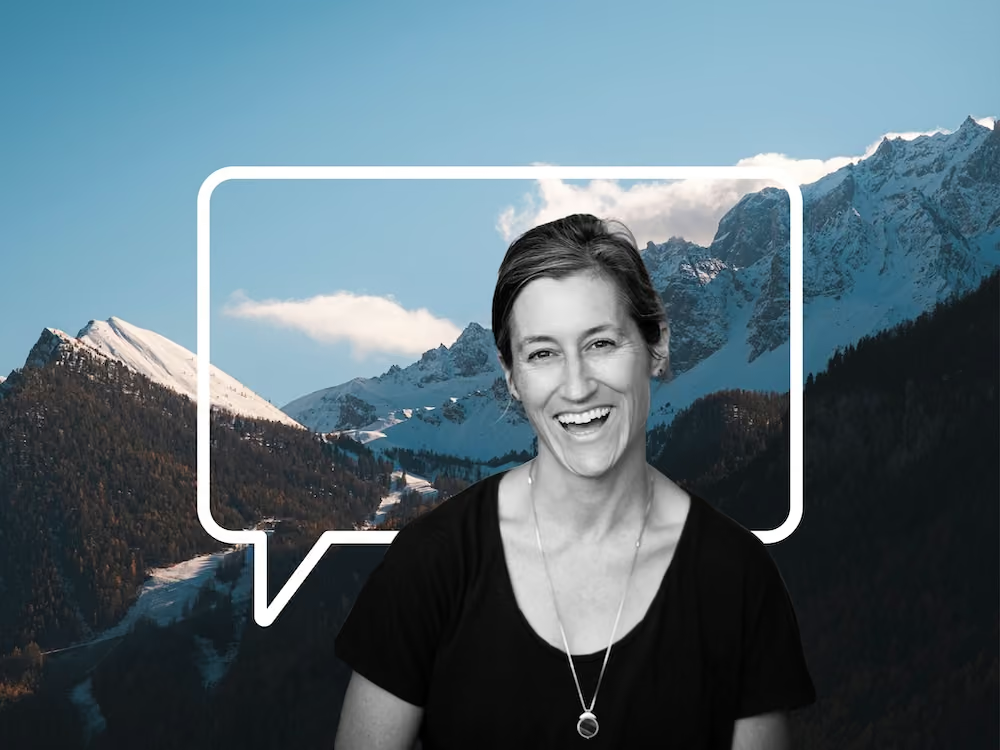
“I'd rather be a brand that has stood the test of time and hasn't been a fair-weather sustainability brand. I want to be able to show that we've stuck to our values in good weather and bad weather.”
This conversation between 1% for the Planet CEO Kate Williams and Peak Design’s Annie Nyborg took place as part of the Our Planet Talks virtual series, in which we celebrate member stories and hear about the many ways they bring purpose into their operations. You can find the full recording here.
Annie is the Head of Environmental and Social Impact for Peak Design, a San Francisco-based product design company. She oversees the company's environmental and social initiatives, including supply chain standards, government affairs, 1% for the Planet giving and decarbonization. She also serves on the boards of The Conservation Alliance, The Change Climate Project and the Ojai Valley Land Conservancy.
Kate Williams: Congratulations on your 10th anniversary of being a 1% for the Planet Member. That's a long time, and I've had the great gift of being there for all of those 10 years. It's been such a delight to work with you and to see the way you've become an incredible leader in our network. Take me back to 2016 when the decision was being made. What were the conversations like at the leadership level, and what made it a yes for all of you?
Annie Nyborg: I wish I had a great game plan for sustainability leaders out there, because this is the question many of them wrestle with—how do you get leadership on board? I was very lucky. We were a bunch of kids starting a company. I started at Peak almost 12 years ago, and we were a team of about 11 people at the time. Remarkably, our CEO agreed to let me work on corporate responsibility as pretty much a full-time job, and the first thing I wanted to do was become a 1% for the Planet Member.
I went to great lengths preparing a thorough PowerPoint presentation that I was going to present to the team and to Pete, our CEO. I was ready to go to bat for this and really fight my way to the finish line. But very fortunately, everyone just kind of looked around and Pete said, "Yeah, sounds like a great idea. Let's do it."
I had it pretty lucky at the time, though I didn't realize to what degree it was going to become a catalyst and foundation for our entire environmental and social impact program. It really was what started everything.
Kate Williams: What has been the most interesting thing you've learned, or something that has surprised you since becoming a member 10 years ago?
Annie Nyborg: I think what still sometimes surprises me is that even employees, and definitely people outside 1% for the Planet, assume that a brand gives 1% of their revenue to 1% for the Planet and then 1% for the Planet distributes that money. In fact, brands get to decide where that money goes. And not only does the brand get to decide where the money goes within the vetted nonprofit network, there's a lot of creativity and innovation that can go into that giving.
Peak Design originated in the film and photography industry. Our network is filmmakers and photographers, and we really believe in the power of storytelling and how important film and photography can be in educating the public on environmental issues and creating calls to action to mobilize people and get policies across the finish line.
Filmmakers would approach us wanting sponsorships to create important environmental pieces, but we didn't have additional funding we could give them. Then we figured out that a lot of times they were working with vetted nonprofits on these issues. So we worked with the filmmaker and the nonprofit to donate to the nonprofit the cost it would take to create the piece, and they would pay the filmmaker. We've created some really impactful, beautiful pieces through that partnership of filmmaker, nonprofit and Peak Design.
There's a lot of creativity in how you can maximize impact with your giving. It's about thinking outside the box a little bit.
Kate Williams: You have access to this community of network partners—brands navigating similar issues. Can you describe some value you've found being part of the network, the community and specific collaborations that have been valuable?
Annie Nyborg: There's an automatic level of trust and respect for other brands that are 1% members. Even if you've never talked to anybody from that company or don't really know anything about them, I will take a call from anybody who's a 1% member, and anyone will take a call from me if they're a 1% member because we have that shared value and shared commitment.
I have found it valuable because sometimes I'm navigating sustainability challenges, but I know another brand has already addressed those same challenges. I can pick up the phone and say, "Hey, 1% Network, I have a question about this. Will you take my call and help me out?" That's really invaluable, especially navigating the constant flux of sustainability, which is always changing, always a challenge, always uncharted territory.
Kate Williams: You've been incredibly creative with your giving—a mix of monetary, in-kind, volunteering and advertising donations. How has your approach to giving evolved over the years, and what's different today than it was 10 years ago?
Annie Nyborg: When we first got started, we were like, "Hey, that organization looks good. Let's write a check and send it to them." We've really become much more thoughtful and sophisticated about how we give and how to maximize the impact of that giving.
1% was a catalyst and foundation for our environmental and social program. In an ideal world, every brand would have separate budgets for different environmental initiatives—climate and decarbonization, advocacy, supply chain workers' rights, pure philanthropy. Unfortunately, that's not the world we live in. We need to keep the lights on and pay our employees.
What 1% gave me was a master budget. If I could fit something into that budget, I didn't need to sign off from leadership. It was so much easier to get a yes because it was like, "Is this going to cost anything?" And I'd say, "Nope, it's coming out of 1%." They'd say, "Great, go forth and do it."
It's a win-win. I was able to weave in our Climate Label work, our decarbonization work, our Fair Trade program, our B Corp fee, our advocacy program—all of it under the 1% bucket. It fits in that Venn diagram of helping us build our program as an individual company while helping an organization like the Conservation Alliance and supporting the larger environmental movement. We've been trying to be more strategic and smart about how we leverage our giving and find multiple wins through it.
Kate Williams: Can you give us a story of a giving partnership that you feel particularly proud of, or that was particularly instructive?
Annie Nyborg: The one organization we've been with for all 10 years is the Conservation Alliance. We've seen a really interesting growth in that organization over the time we've been together. When we first joined, they were primarily a regranting organization—you'd give them money, they'd find really important grassroots nonprofits to fund, and then we would fund those.
But they realized that to have greater impact, they needed to bring in the advocacy component. So they give to grassroots organizations while also advocating for their work at a primarily federal level. We got to be on this journey with them as they became a more impactful organization. They taught us everything we know about advocacy. I had no idea what advocacy was or how an organization could get involved with it. That was a huge development for us. Partnering with them was understanding what advocacy is and how we could get involved with it. It's been a very long-standing partnership.
Kate Williams: There's a really strong moment right now around your relationship with the Conservation Alliance, particularly around the Brands for Public Lands initiative. Can you share about your involvement with that and why it matters so much at this moment?
Annie Nyborg: Public lands are very near and dear to my heart. Peak Design is based in the outdoor industry, so people can see the direct correlation between the health of our public lands and the health of the industry. We make products used in these places. If these places didn't exist, it would hurt our business.
But you might think, is that really going to happen? There's a lot of public land, so if a little bit goes away, does it really impact the industry? Yes, it does. It's a tremendously slippery slope, and the precedent it sets is dangerous. Once a piece of land is developed or sold, we're not getting it back. We really need to be careful. Right now we need as much wild habitat and open spaces as we can globally—not just North America, but worldwide.
It's not just the outdoor industry. Our public lands provide water, clean air, climate mitigation in the form of carbon sinks, and public health benefits. There's very clear evidence around the impact of public lands on physical and mental well-being, and that's something the nation is really struggling with in terms of public health.
And then there's economics. Our public lands are a huge economic force. The outdoor recreation industry is a $1.3 trillion industry—bigger than oil and gas. What's so cool about this economy is that it's sustainable. This economy can provide revenue for surrounding communities forever if we take care of the source—our public lands. And it's not just outdoor; it's the grocery stores, the hotels, the mom and pop shops.
For better or worse, businesses have tremendous influence over policy decisions. So it really behooves the business community to get involved and get loud and proud about their support of public lands.
What's also cool is that a super majority of the population is in favor of protecting our lands and properly managing them—left, right, old, young. It's not sticking your neck out. Brands on either side of the aisle can get involved with protecting these lands. Customers love seeing that. It's the one issue area that really brings people together.
And I understand if you're a brand and don't know how to get involved, it can feel overwhelming if you don't know what advocacy is. But that's where a coalition like Brands for Public Lands, the Conservation Alliance, and other conservation advocacy groups will guide you. They're the experts. We think of the Conservation Alliance as our government affairs team. They tell you what issues to prioritize, how to get involved, the script you can use for social media, what letters you can sign on to, which representatives you should call. It just makes it really easy for you. Even if everybody just got a little bit involved and made one call or signed one letter, it would move the dial.
Kate Williams: How do you think about the package of multiple certifications—B Corp, Climate Label, Fair Trade, 1% for the Planet? What's the bigger picture you're telling consumers and employees?
Annie Nyborg: They all fit a different part of our company and address a unique area of sustainability and running a responsible company. You shouldn't just get the badge for the badge's sake. We don't need more badges. You can do good work without the badge. But these certifications provide us, especially as a small sustainability team, the ability to do a lot of good work without reinventing the wheel. They've done all the hard work in distilling best practices and building a framework, and you can just apply it.
Certifications have served three roles for us. First, there's the framework role—I don't have to figure out how to take care of our factory workers or how to think about carbon accounting. Fair Trade helps with that, or the Climate Label helps with that. We take those frameworks and use them.
Second, there's accountability. While you don't need the badge, it's nice to have a third party looking over your shoulder, making sure you're doing what you're saying you're doing. And they work with you as a partnership to help troubleshoot when you're stuck.
But lastly, and I think most importantly, is growth and movement-building. For a long time, Peak Design didn't care about advertising our good work—we just knew we wanted to do it. We didn't care about marketing it. But we wanted to advertise less for our sake and more because we wanted to grow that movement and initiative that B Corp or 1% or Change Climate were trying to build. Certification helps not only your own company but also builds the movement and creates brand awareness for what those organizations are trying to do.
Kate Williams: Do you have stories or data points from work with your consumers or employees that show how those certifications play into their connection to your brand?
Annie Nyborg: We get quite a bit of qualitative data—customers coming into our retail stores telling us how much they appreciate it, comments on our social media. Honestly, I think in every employee interview we've had in recent years, one of the top reasons someone wants to come work for Peak Design is our environmental and social impact work.
Kate Williams: Given everything that happened in 2025 and what’s unfolding in 2026, what's your advice to other leaders trying to either step into or hold the line on values and environmental commitments?
Annie Nyborg: The pendulum's going to swing. Historically we've seen lots of pendulum swings, so at some point the pendulum's going to swing back, hopefully in the not too distant future. I'd rather be a brand that has stood the test of time and hasn't been a fair-weather sustainability brand. I want to be able to show that we've stuck to our values in good weather and bad weather.
There's both a business case for that and an ethics case. And I know that seems wishy-washy and it's hard to sell to a CEO, but what kind of person do you want to be? What kind of brand do you want to be? I think we as humans have a moral compass and we abide by it, but somehow it breaks down at the company level. Don't do that. Demonstrate that you're bringing your ethics and values to your company level. I know it's easier said than done, especially at my level where we're not the CEOs calling the primary shots.
For me, at a tactical level, we need to try to do everything we can to hold on to the gains we've made and hope we can make it out with as much intact as possible. I've been approaching that by developing a nuanced understanding of how these initiatives fit into a larger business case—whether that's regulatory, compliance or liability—and making those arguments to leadership so they're not on the chopping block.
For example, we're a B Corp and we're recertifying right now with some very aggressive standards. B Corp is important as a business reporting protocol, and in the new B Corp standards you have to have an advocacy component, a climate component. Now I can say these are reporting requirements and regulatory—we have to have this. It's not a choice. That makes it an easier sell to leadership.
Kate Williams: If you were sitting down for tea with someone in an equivalent role who wanted to bring these commitments to their company, how would you advise them on getting leadership across the line?
Annie Nyborg: It really depends on the size of the company, where they are in their journey and the proclivity of leadership to jump into something like this. It would have to be really case by case.
That said, if you think you can get a 1% commitment out of them, do that. As Peak has demonstrated, you can build all the program stuff under that 1% commitment. If that's too much of an ask, then figure out that one program component you think they might want to do and double down on that.
I would probably take the compliance or liability tack. There are good arguments now that can be made to leadership around why not taking care of your factory workers is a real business liability, or why not doing better carbon accounting and decarbonization is going to challenge your ability to sell to certain retailers and distributors. You don't want that to be a hurdle to growth.
But the number one thing I would recommend: get one person to get 1%. That took all the friction away for me. I was able to be like, "Now we're doing Fair Trade, now we're doing B Lab, now we're doing … " and it didn't matter because all of it could fit under this umbrella of giving. We still have a bucket of pure philanthropic giving—write the check and don't expect anything from it. But we can also do all this other incredible programmatic work without any friction of begging for resources from leadership.
If an organization is able to get into the 1% ecosystem, push for that. Then you can build an entire program underneath it.
Kate Williams: How do you think about your company's impact holistically? It goes beyond philanthropy—offsetting your entire carbon footprint, the Peak Design marketplace for consumers to resell products.
Annie Nyborg: The holistic nature is almost a byproduct of thinking about impact in highest ROI terms. I'm looking for: What can we do as an organization to mitigate our environmental and social damage? What's the high-impact area? What's our greatest return on investment in terms of impact? Where can we have the biggest bang for the buck?
Almost naturally, that means going for the low-hanging fruit across a broad swath of things—what materials can you use, who can you donate to, what advocacy can you do, what climate mitigation work can you do? You kind of scoop up all that low-hanging fruit that has really high ROI, then continue prioritizing: What initiative can I do next that has maximum impact, given my sphere of influence and abilities?
For us, it's almost naturally led to a very holistic corporate responsibility program. Some companies very strategically go deep in one area, and I think that's just as valid. Those companies end up moving the playing field or pushing progress further because they go deep in a subject. I'm really grateful for those companies because they can push various sustainability initiatives further than a generalist approach can.
For us, it's always been about: Given our resources and sphere of influence, where can we have the greatest impact?
Kate Williams: Peak Design has stood out in encouraging other businesses to join 1% for the Planet. Some companies worry about giving away their competitive edge. You've always been the opposite. Can you explain why and what you see as the value of movement building?
Annie Nyborg: I want it to become like a black hole—I want to grow it to suck more people in. I want to create that mass. I want it to become the thing that everyone just does because everyone does it.
We've never seen it as competition. I think it just stems from ethics and values and what's the right thing to do as a business. In one sense, you're creating competition because then you're another brand with the 1% logo. In another way, you're decreasing competition in that you're equalizing the playing field—everyone's looking at planet, people and profit instead of just profit.
And over the last 10 years, Peak Design has grown immensely. There are many reasons for that, including our amazingly good products. But our impact commitments are not nothing—they're not an insignificant part of that growth. Building that movement is part of building your own growth.
Kate Williams: Looking ahead, what are you thinking about for the next 10 years? What are you focused on? What are you excited about?
Annie Nyborg: I'd classify us as solidly middle-sized, and I think we're looking at some solid growth over the next five to 10 years.
Really, what success will look like for me is if we can demonstrate that you can be a very successful company while not giving up your values and your environmental and social impact work. I want to demonstrate that there are more companies out there that can do it, and can do it very successfully. There's no excuse not to do it. I want to point to companies like Peak Design and say, "Look at these companies. They're doing it and they're doing it really well."